
Essex County Court Records After Arrest
An Essex County arrest can start with a traffic stop, patrol call, warrant, town or village police case, state police case, Sheriff's case, or federal law-enforcement matter. The Sheriff's Office is led by Sheriff David Reynolds. If the person is held locally, jail intake creates the custody side. The court side begins when charges are filed and the case is placed before a local justice court, Essex County Court, or another court with authority over the matter.
The Essex County District Attorney represents the People in criminal proceedings and works with agencies named in the research, including the New York State Police, Essex County Sheriff's Department, Ticonderoga Police Department, Lake Placid Police Department, Moriah Police Department, Saranac Lake Police Department, and state or federal partners. That means the arresting agency may be local, but the court records after a jail arrest are tracked through the court system once charges are filed.
Booking detail and custody status belong with jail inmate records. Formal charges, court appearances, warrants tied to missed court, bail conditions, motions, dispositions, and sealed status belong with the court case.
When the court record does not answer the custody question, use the same custody-channel split used for Essex County inmate records: call the jail, check VINE, search DOCCS after a state-prison transfer, use BOP for federal sentenced custody, and use ICE for immigration detention.
Find Essex County Court Records After Arrest
New York WebCriminal is the main public online starting point for pending criminal case information where the court and case status are available. It is not a jail roster, and it does not replace a call to Essex County Jail when the question is whether someone is currently in custody. It is the better source for the filed case, court calendar, case identifier, and charge list.
- Open WebCriminal and choose the path that fits the information you have: Case Identifier, Defendant, or Court Calendar.
- Search by defendant name when no docket or case number is known. Narrow with court or calendar information when possible.
- Open the case entry and read the charge list, court, next appearance, and status shown in the court system.
- Compare the court charge status with jail custody information, because booking charges can differ from charges later filed or amended by the prosecutor.
The WebCriminal entry page shows the Case Identifier, Defendant, and Court Calendar search paths used for criminal case lookup.
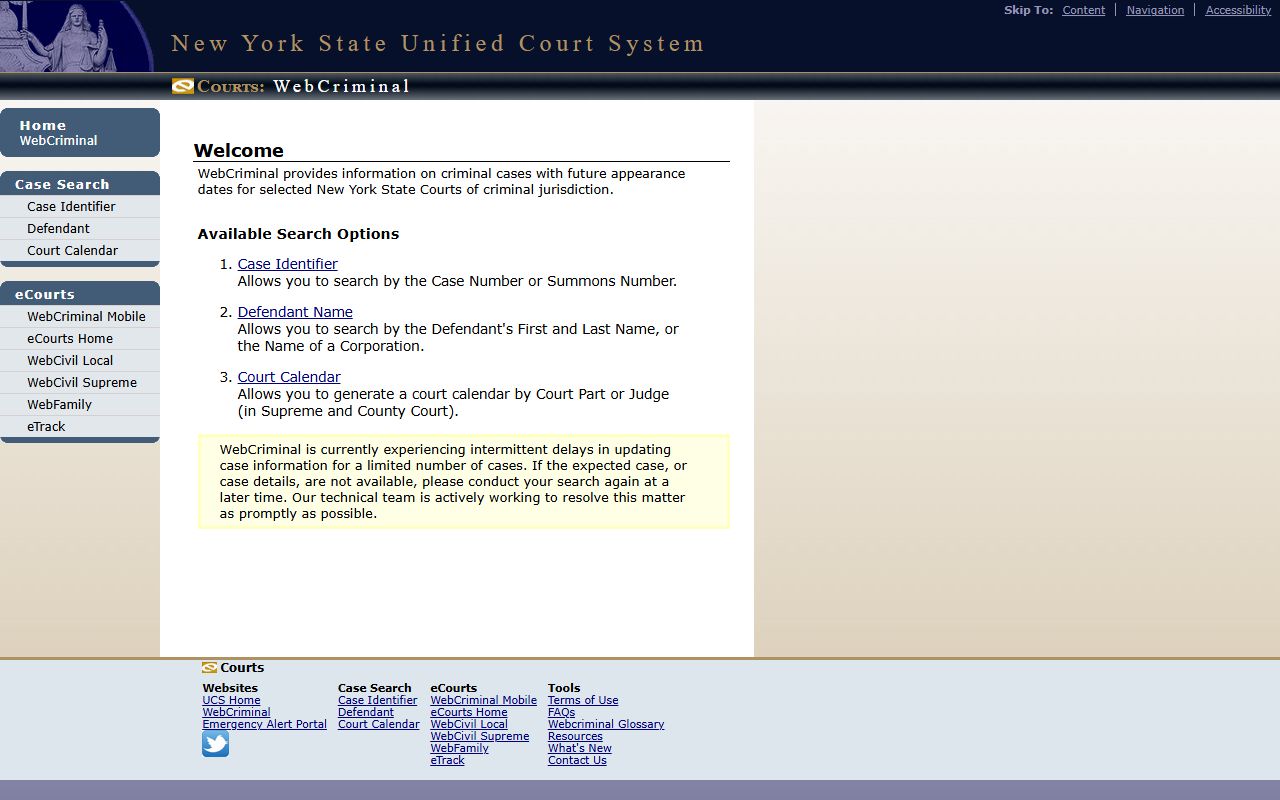
The search paths are useful after an Essex County arrest because the court record may appear even when the county jail does not publish a public roster.
Essex Court Records Search Fields
The research file captured WebCriminal as a search entry point rather than a sample person record. Its fields are organized by search path. Use the case identifier when known, use defendant search when only a name is known, and use court calendar search when the issue is the next appearance date.
| Field Label | Type | Required | Options or Notes |
|---|---|---|---|
| Case Identifier | tab / search path | Optional | Search by case, docket, summons, or other identifier where known. |
| Defendant | tab / search path | Optional | Search by defendant name when no docket number is available. |
| Court Calendar | tab / search path | Optional | Search by court and date to locate scheduled appearances. |
| eCourts links | navigation | n/a | Includes WebCriminal Mobile, eCourts Home, WebCivil Local, WebCivil Supreme, WebFamily, and eTrack links. |
Charges After an Essex Arrest
Charges after an Essex County jail arrest may begin with a complaint or other accusatory document. Depending on the charge level and case path, the record may later involve an information, superior-court information, or indictment. The key point is simple: an arrest charge is an accusation tied to booking and initial custody, while the court record is the official case path that tracks what the prosecutor filed and what the court did next.
| Document | Who Uses It | What It Does |
|---|---|---|
| Complaint | Law enforcement or prosecutor | Starts or supports a criminal case with allegations and facts. |
| Information | Prosecutor or court process | Can replace or support a complaint when legally sufficient details are filed. |
| Indictment | Grand jury | Charges felony counts after grand jury action. |
The District Attorney's page says the office handles criminal proceedings in Essex County Court, Essex County Supreme Court, and twenty local justice courts. Some arrests begin in a local court and later move to County Court depending on charge level, indictment, waiver, plea path, or other procedure.
Essex Charge Status Meanings
Charge status can change after a jail arrest. A booking record may use the initial offense or commitment basis, but the court record may later show an amended charge, added count, dismissed count, conviction, sealed disposition, or sentencing event. When a reader sees more than one charge source, the court record is the better source for the formal case status.
| Status | What It Means |
|---|---|
| Pending | The charge is still active and has not reached final disposition. |
| Amended or reduced | The charge has changed from the original count, often through prosecutor action, motion practice, or plea negotiation. |
| Dismissed | The court has dismissed the charge. Sealing rules may affect later public access. |
| Convicted | The person was found guilty or entered a guilty plea to that count or a replacement count. |
| Sealed | The public view is restricted by statute or court rule. |
Essex County Court Contacts
Essex County Supreme and County Court is in Elizabethtown. The New York Courts page lists court hours as 9 a.m. to 5 p.m. and identifies the Chief Clerk and Deputy Chief Clerk. The County Clerk's office is also at the courthouse complex and keeps records and public office hours. Older files, e-filed documents, and court-specific access questions may require the court clerk, County Clerk, WebCriminal, NYSCEF, or CHRS depending on the record.
Essex County Supreme and County Court
7559 Court Street, P.O. Box 217
Elizabethtown, NY 12932
518-873-3370
Public hours listed by New York Courts: 9 a.m. to 5 p.m.
Essex County District Attorney
7559 Court Street, P.O. Box 217
Elizabethtown, NY 12932
(518) 873-3335
District Attorney Michael P. Langey.
The New York Courts Essex County page lists the court address, clerk contacts, hours, and e-filing note.
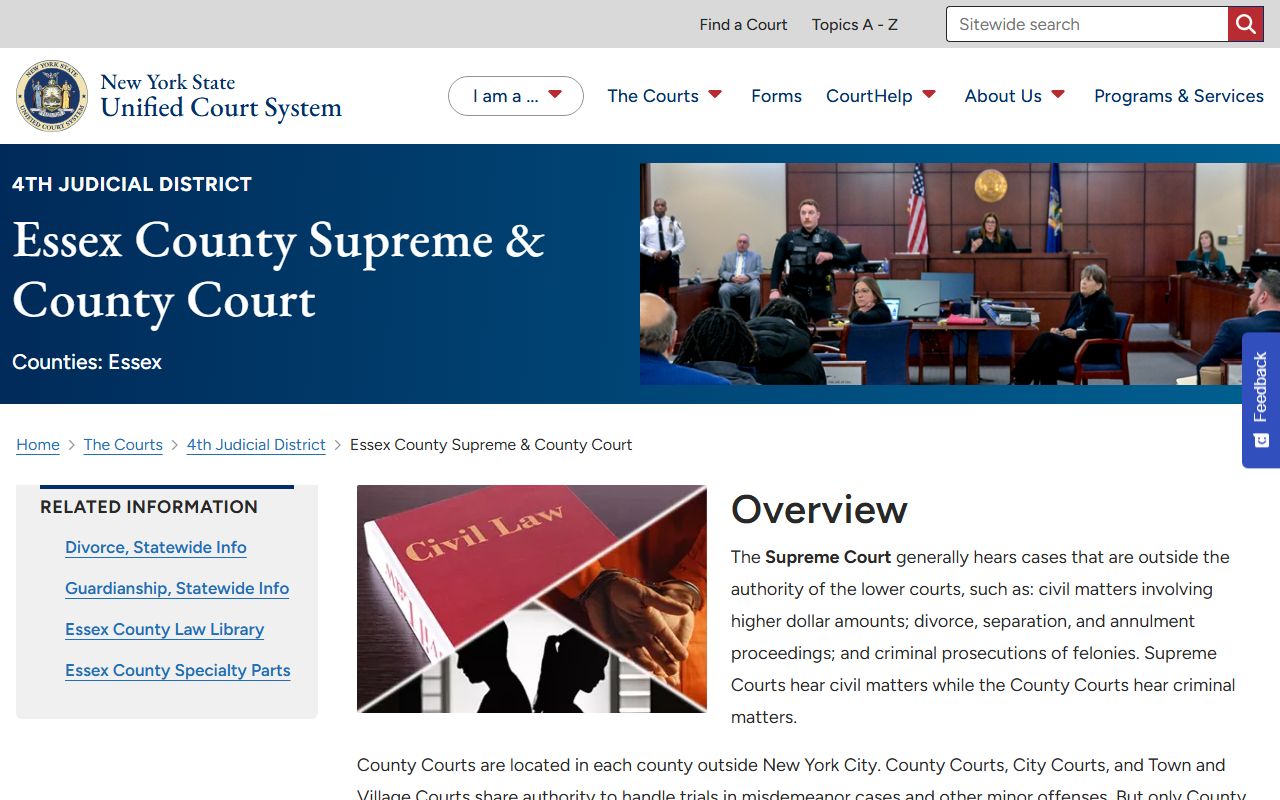
Use the court contact when a WebCriminal entry is unclear or when a case requires clerk review rather than a custody lookup.
Bail After Essex County Arrest
Release decisions in New York criminal cases are made by the court, not by a jail web page. After arraignment, the court may release a person on recognizance, set non-monetary conditions, set bail or bond where legally permitted, or remand the person where the law allows. Essex County Jail can process release only when the court order and all holds allow it.
| Release or Bail Type | How It Works |
|---|---|
| Recognizance release | No money is posted. The person promises to return to court. |
| Non-monetary conditions | The court may order reporting, supervision, travel limits, treatment, or other conditions. |
| Cash bail | Money is posted in the amount authorized by the court. |
| Secured or surety bond | A bond mechanism may be used where legally available and accepted by the court. |
| Remand or no-bail hold | No payment will release the person unless the court changes the order or another hold clears. |
The Sheriff's corrections page links online bail through GovPayNet/AllPaid with PLC Code 1995. Before paying, confirm the defendant, court, amount, and release conditions with the court or Essex County Jail. A detainer, warrant, parole issue, state-ready transfer, federal hold, or immigration matter can block release even after a payment.
Warrants and New Essex Bookings
No official Essex County Sheriff's searchable criminal warrant list was located on the Sheriff or county site. A warrant can still lead to a jail arrest and then to court records. Common warrant contexts include an arrest warrant, a bench warrant after missed court, a parole warrant, an out-of-county hold, or a federal hold. If a person is booked on a warrant, the jail custody question and the court case question may need two separate checks.
Search WebCriminal for the case or calendar entry, then call the relevant court clerk if a missed appearance or bench warrant is suspected. For current custody, call Essex County Jail. If the case record is not public or the warrant type is unclear, a lawyer, court clerk, or issuing agency may be the only reliable source.
Note: Do not rely on unofficial warrant pages when no official Essex County warrant search was found in the research.
Charges Versus Convictions
Being arrested and charged in Essex County is not the same as being convicted. A charge is an accusation that must move through the court process. A conviction occurs only after a guilty plea, verdict, or other legal disposition that results in guilt. Court records after a jail arrest should be read with that distinction in mind, especially early in the case.
| Point | Charge | Conviction |
|---|---|---|
| Case stage | Accusation or pending count | Final or resolved guilt finding |
| Proof level | Begins with legal accusation and probable cause standards | Requires plea or proof beyond a reasonable doubt |
| Can change | May be amended, reduced, added, or dismissed | May affect sentence, release, supervision, and criminal-history results |
Sealed Essex Court Records
New York records can be restricted by sealing rules, youthful-offender rules, juvenile confidentiality, dismissal sealing, and other statutes. The research file did not identify a local Essex rule that makes all jail-arrest case materials public. Public Officers Law Article 6 and section 87 create access rights and exemptions, while court-specific rules decide whether a case or document is public.
| Point | Sealed | Expunged |
|---|---|---|
| Public view | Hidden or restricted from ordinary public access. | New York commonly uses sealing rather than broad expungement for many criminal records. |
| Agency access | Some agencies may retain limited lawful access. | Depends on the specific statute or order. |
| How to verify | Check with the court, clerk, or counsel. | Do not assume removal from a website proves the legal record no longer exists. |
CHRS is a separate statewide court-system search. The New York Courts records help page states that CHRS returns public records for open, pending, and conviction records from courts across New York and excludes sealed records. The research file lists the CHRS fee as $95 per search. DCJS record review is different because it lets a person request their own state criminal history through fingerprinting and service codes.
FOIL and Court Record Limits
FOIL is useful for agency records such as jail booking records, commitment and discharge records, incident reports, and some booking-photo requests. Essex County FOIL requests must be in writing to the County Attorney's Office. Court case access is often routed through court systems, clerks, NYSCEF guest search for e-filed cases, WebCriminal, or CHRS rather than a county FOIL email.
The Essex County FOIL page gives the written request channels, including email, fax, mail, and appeals officer information.

Use FOIL for county or Sheriff's records, but use the court record systems when the question is the filed criminal case.